Hockey in the land of sand
A History of the Qatar International Ice Hockey League
There are easier places to start a hockey league than Qatar.
In Canada, you need players, sticks, pucks and ice. In Doha in the early 2000s, the ice was the difficult part.
Yet in 2002, a small group of expatriates began gathering to play hockey. What began as people trying to continue playing the game they loved grew into the Qatar International Ice Hockey League - the QIIHL, or simply “the Q.” Over the next two decades, the Q would produce championships, international tournaments, travelling teams, Qatari players, national-team athletes, an Olympian, lifelong friendships, questionable officiating, spectacular goals, terrible goals, aging players refusing to acknowledge time, and a peculiar system in which even the goalies did not really belong to anybody.
It was serious hockey. It was also rarely serious. And that may be the best way to understand the QIIHL.
Explore the history
Finding Ice in the Desert
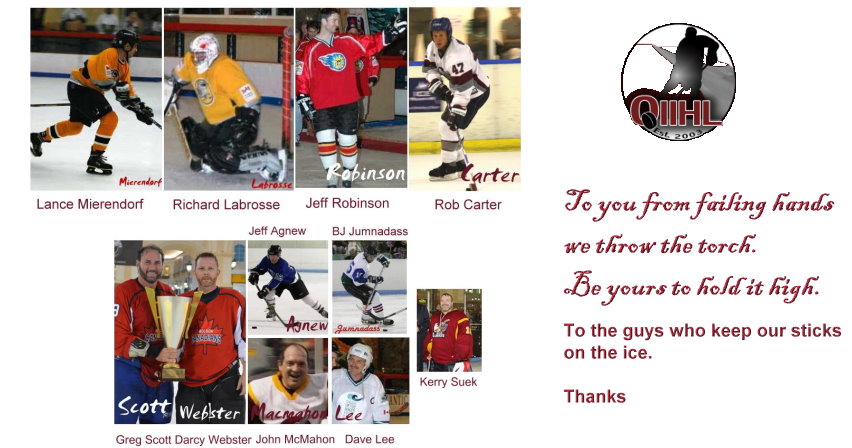
The QIIHL traces its beginnings to 2002, with formal league competition following in 2003. Lance Mierendorf and Richard Labrosse are credited with establishing the organized league, and its championship trophy would eventually bear their names: the Mierendorf-Labrosse Cup. The inaugural league consisted of four teams, with the Ice Cruisers becoming the first champions in 2003.
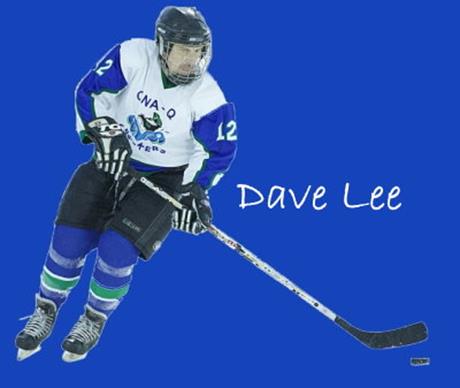
Among the players arriving during those earliest days was Newfoundlander Dave Lee, who came to Qatar in 2002. He would remain part of the Q for twenty years - player, referee, fundraiser, committee member, ambassador and Desert Cup organizer.
The early hockey was played at City Center Mall, and conditions required creativity. At various points the game was played four-on-four, and the earliest players reportedly used a ball rather than a puck. It was an unlikely beginning. But enough people wanted to play that the Q survived. And then it grew.
More Than Canadians
Canadians played an enormous role, particularly with the growth of the College of the North Atlantic-Qatar community, but the Q soon became something more interesting. Players came from Canada, the United States, Finland, Sweden, Russia, Slovakia, Switzerland, the Czech Republic, Australia, France, Ireland and elsewhere. Eventually Qataris joined them. The Q became an international community held together by hockey.
CNA-Q, the Qanucks and the Desert Cup
CNA-Q became an important force in Doha hockey. The CNAQ Breakers became one of the league’s strongest teams, while people associated with the college helped organize hockey and introduce new players to the game. In 2005, a Canada-versus-Qatar game became an early landmark. H.E. Sheikh Abdullah Bin Mohammed Bin Saud Al Thani participated in the ceremonial puck drop, and footage later appeared in Hockey Day in Canada coverage connected with Stephenville, Newfoundland and Labrador.
First played in Qatar in 2007, the Desert Cup brought recreational teams from elsewhere in the Gulf and beyond to Doha. The travelling Qatar Qanucks represented the community outside the country. Hockey in Doha was no longer merely surviving. It had become a destination.
The Q Finds a Home
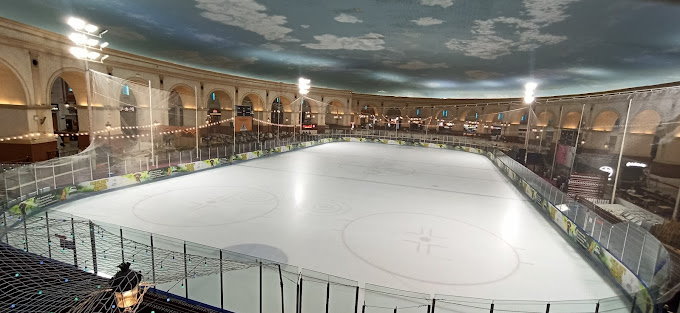
The Gondolania Ice Rink at Villaggio Mall transformed the league. Sunday nights and Friday mornings became hockey time. Players who spent their weeks in offices, schools, aircraft, hospitals, laboratories, oil and gas operations and businesses across Doha arrived carrying hockey bags into a shopping mall. Inside was a small piece of winter.
As participation grew, the range in ability became impossible to ignore. The Q responded with divisions - principally A and B, and at times A, B and C. In 2020, Paul Warriner made his A-Division debut at age 64. Q Beat asked why scouts had overlooked him for six decades. “I never make the same mistake twice. I make it five or six times, just to be sure.” Asked what advice he had for anyone chasing the dream, Warriner answered: “Just keep going, keep playing... You never know.” [Q Beat ↗] That was the Q.
In 2010, the QIIHL sponsored Qatar’s Red Bull Crashed Ice qualification tournament. Bill Chase, a SandVipers player, won the competition.
Enter Q Beat
As the league matured, its games acquired their own chronicler. Vince Stack, a longtime QIIHL player, began writing league reports under the name Q Beat. Calling them game reports was technically accurate in much the same way that calling a Zamboni a motor vehicle was technically accurate. Scores were reported. Usually.
Q Beat was principally interested in the characters inhabiting the Q. Good players were celebrated, bad players were mercilessly - but generally affectionately - described, referees were accused of incompetence, aging players were reminded of their mortality, and post-game quotations occupied a region somewhere between journalism and complete fabrication. The Q took hockey seriously. Q Beat made certain it never took itself too seriously.
When the struggling Canadians were comprehensively outplayed, Ryan Brendzy assessed the performance: “We stunk. We skated bad. We were terrible on defense, and our passing game made up for it by being absolutely horrible.” There was one positive: “We drank from our water bottles fairly well.” [Q Beat ↗] Newcomer Tim Groeneweg appeared promising despite periodically throwing up on the bench. Q Beat asked how to pronounce his name. “Tim.” [Q Beat ↗] Silver Surfers captain Jarkko Rantakallio revealed the tactical secret behind his team’s success: “Any time we score more than 3 goals and hold the other team below 3 goals, we almost always win.” [Q Beat ↗]
The Keepers of a Lonely Heart
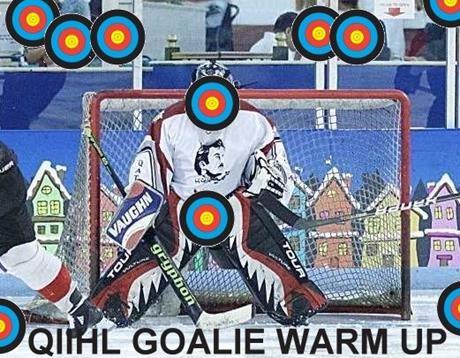
Nothing illustrates the peculiar nature of QIIHL hockey better than its goalies. In the early days Qatar did not have enough of them, so the Q invented a solution: the goalies switched teams halfway through the game. The shortage eventually eased. The tradition did not.
Q Beat described the QIIHL goalie as a “padded crouching Cro-Magnon guarding his six-foot-by-four-foot metal cave.” There was Glenn “Gman” Robinson, the Qatar Airways pilot with mongoose reflexes; Danial Hariri, whose legs descended like the landing gear of a 737; Kerry Suek, the self-taught stand-up goalie who rejected the butterfly as soulless percentage hockey; Mark Allan, whose response was “Tell Suek to shut his five hole”; and Thomas Tyson, whose glove was described as so fast that a 100-mph shot disappeared into a 101-mph hand. The Q was not an ordinary league. [Q Beat ↗]
The Women of the Q
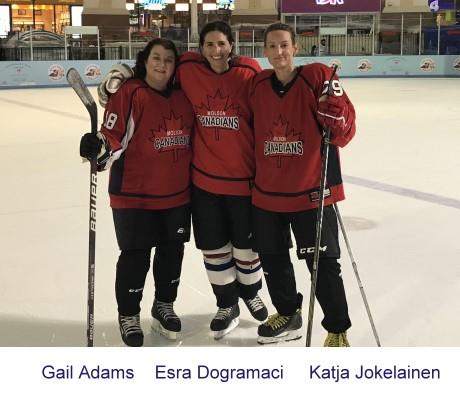
Women increasingly became part of QIIHL hockey. Katja Jokelainen scored what Q Beat recorded as the first goal by a female QIIHL player since Mary Tilley in 2009, prompting the headline “Katja Jokelainen Breaks Glass Ceiling.” [Q Beat ↗] Then Jokelainen joined Esra Dogramaci and Gail Adams to form the first all-female forward unit to start a QIIHL game. They produced all of the Canadians’ offence in an 8-2 loss. Asked whether she had been nervous, Jokelainen replied that hockey did not make her nervous. Parallel parking in front of people did. [Q Beat ↗] Dogramaci had represented Australia internationally and trained within Canada’s national hockey program. [Q Beat ↗]
The Oryx: Qatar Takes the Ice
The early league history recorded an ambition to form a team of Qatari players and develop a national ice hockey team.
Perhaps the most consequential change was the development of Qatari players. The Qatar Oryx brought a younger generation into league competition. Initially their speed and enthusiasm sometimes ran ahead of their experience. Over time, Q Beat noticed them becoming not simply better players, but a team. [Q Beat ↗]
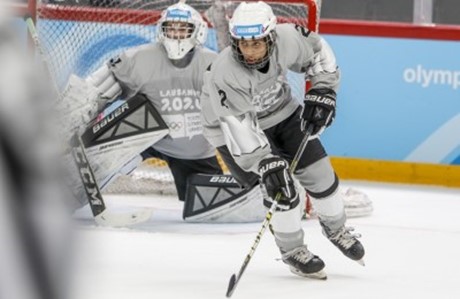
Players such as Ahmed Alobaidly, Thawab Al-Subaey, Abdulla Zouzou and Naif AlRumihi represented something difficult to imagine during the earliest City Center games. Qatar was producing hockey players. In 2020, Oryx player Thawab Al-Subaey was selected for the boys’ 3x3 mixed ice hockey tournament at the Winter Youth Olympics in Lausanne. QIIHL records described him as the first Qatari selected for a Winter Olympics event. A game imported by expatriates had taken root. [Q Beat ↗]
The Players Became Characters
Q Beat created a mythology around ordinary recreational hockey players. Petr Gagyor became almost supernatural, his skating described as “the streaking light which makes the darkness visible.” [Q Beat ↗] Keith Loder seemed immune to age, circling down low “part shark, part man.” [Q Beat ↗] Hady Fink became an example of persistence: when he first joined the Q, players from both teams supposedly chanted “Rudy, Rudy, Rudy.” He kept playing and became an important A-Division player. [Q Beat ↗] Tim Crowley was so consistently good that his excellence became almost invisible. After setting up a magnificent goal, Crowley’s celebration was equally extravagant. He raised an eyebrow. [Q Beat ↗]
These portraits preserved something statistics could not. They preserved the people.
Referees, Penalty Boxes and Other Hazards
The Q’s referees included many of the same people who played in the league. Marc Haddad became famous for jumping onto the boards when the puck approached him. Dave Lee enjoyed replacing a dislodged net. Jan den Dulk enjoyed removing stray tape. Charles Fullerton supposedly needed a fundraiser for laser eye surgery. Haddad’s striped jersey, Q Beat reported, required no special purchase because he had previously worked at Foot Locker. [Q Beat ↗]
Then there was Jay DaCosta. After Haddad assessed DaCosta a misconduct, league officials discovered that the player had apparently disappeared from the penalty box. Q Beat reported: “DaCosta Tunnels Out of Penalty Box.” [Q Beat ↗] DaCosta could not be reached for comment. His agent Chad Martin maintained: “DaCosta didn’t do nothin’.” Whether every detail survived the Q Beat fact-checking department is best left to history.

Winning, Losing and the Canadians
Every league needs somebody to lose. For a memorable period, the Canadians accepted that responsibility. They lost so consistently that Q Beat announced their “first win of the decade” when they finally broke through. [Q Beat ↗] Their total team weight approached 4,000 pounds. They possessed excellent outside shooters, unfortunate because all games were played indoors. After one 7-0 defeat, captain Jeff Carlson was asked what he thought of his team’s execution. “Well, the way we’re playin’, I’m all for it.” [Q Beat ↗] Yet the Canadians kept coming back. Which, in its own peculiar way, was another expression of what the Q was about.
When the Joke Stopped
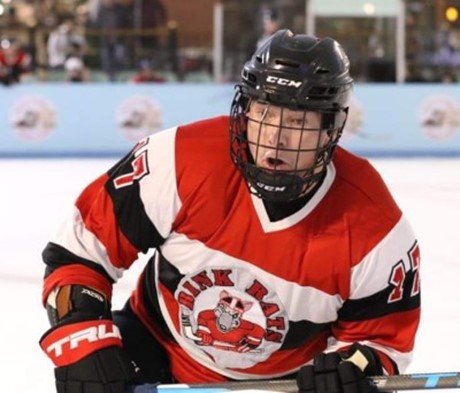
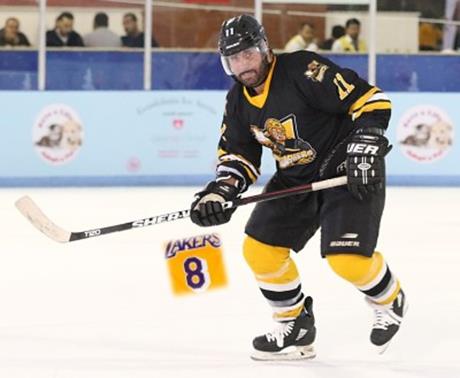
Q Beat could put the jokes away. In January 2020, following the helicopter crash that killed Kobe Bryant and eight other people, Greg Scott left his usual number 11 in the dressing room and wore number 8 in Bryant’s honour. Scott then scored a hat trick as the Dune Bashers defeated the Rink Rats. [Q Beat ↗] Underneath all the absurdity was a real community. People celebrated together. They mourned together. They watched one another’s children grow. And eventually they said goodbye.
Twenty Years of Dave Lee
Few people embodied the Q better than Dave Lee. Arriving in Qatar in 2002, Lee became part of virtually every aspect of the league. When he retired after twenty years, the league recognized a contribution far beyond a scoresheet. [Q Beat ↗] Recreational leagues do not survive because somebody once founded them. They survive because somebody runs the next draft, collects fees, finds sponsors, makes the schedule, referees the late game, answers the new player’s email and brings the pucks. Then, when that person leaves, somebody else does it.
Johnny Mac Says Goodbye
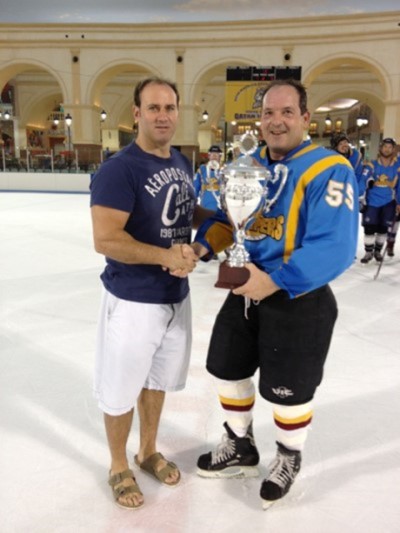
Perhaps no Q Beat story captured the meaning of the league better than the retirement of John McMahon. McMahon arrived in 2010 and spent a decade playing throughout the league. By the time he left for Galway, he had played for so many teams and worn so many numbers that league president Jeff Agnew joked that retiring McMahon’s number would require retiring practically every number in the Q.
Why, Q Beat asked, does a man keep playing hockey at 60? McMahon initially considered beer. Then he gave a different answer. Playing hockey long past your prime, he said, was an attempt to outwit your fading body. You learned to play hurt and with your flaws. Every year you chased a younger version of yourself down the ice, knowing that version was getting farther ahead. Yet every once in a while came a perfect pass, a shot bar down, a deke around a goalie. For a few seconds the years disappeared and the younger player was there again.
It was ostensibly a retirement story. It was really a story about the QIIHL. [Q Beat ↗]
A League of Arrivals and Departures
From its beginning, the Q was shaped by expatriate life. People arrived in Doha for jobs. They found the rink. Someone told them when the next game was. They joined a team. Eventually, inevitably, they left. That turnover could have killed the league. Instead, it became part of its identity.
The teams changed with them: Ice Cruisers, Q-Chem, Desert Heat, CNAQ Breakers, Hammerheads, European Fitness Club, SandVipers, RasGas, Qatar Gas, Sun Dogs, Canadians, Qatar Oryx, Blyth Academy, Silver Surfers, Rink Rats, Oil Kings, Dune Bashers, Shredders, Nomads and others. Uniforms changed. Sponsors changed. Players changed. The league survived.
The Alumni
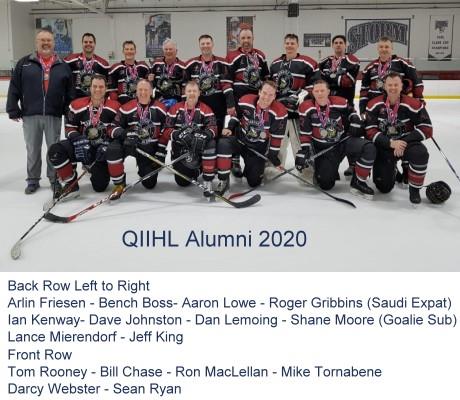
In 2020, former QIIHL players reunited for a tournament in Las Vegas and won silver. Organizer Ronnie MacLellan called it “a great testament to the relationships that the QIIHL experience creates and the power of Sport.” [Q Beat ↗] Championship banners tell you who won. People travelling across countries years later because they want to play together again tells you whether the league mattered.
Then the Rink Went Quiet
In early 2020, the Q was still doing what it had always done. Games were being played. The Canadians were losing. Q Beat was making fun of them. The Oryx were getting better. Paul Warriner was making his A-Division debut at 64. Thawab Al-Subaey had gone to Lausanne.
Then COVID-19 brought organized hockey to a halt. For a league that survived largely because people kept turning up at the rink, suddenly they could not. The silence was strange. But eventually another message appeared: Game On. And in September 2022 came three simple words: “Hockey is back.” [Q Beat ↗] After everything that had happened, that was enough.
The Q Returns
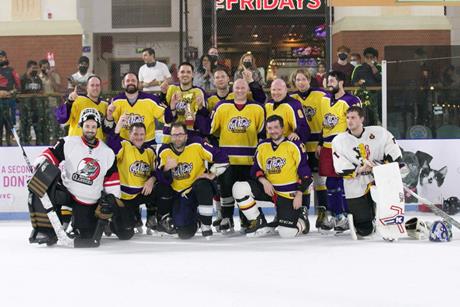
When hockey resumed, the familiar rhythms returned. Players argued about calls. Goalies stopped pucks. Captains complained. Teams made playoff runs. The Oil Kings captured a fall championship by defeating the Qatar Oryx in a three-game final, winning the deciding game 3-0 at Gondolania. Dave “Pee Wee” Lee scored in the championship game and Peter Gagyor added another. [Q Beat ↗]
The remarkable part was not who won. The remarkable part was that there was still a QIIHL in which to win it.
What Q Beat Recorded
Statistics preserve one version of sporting history. They tell us who scored, who assisted, who won and who lifted the cup. But statistics cannot tell us what a league was like.
That is where Q Beat became important. The reports became an irreverent running record of the people who inhabited the league: stars and terrible skaters; women making history; a 64-year-old rookie; Qatari players developing before everyone’s eyes; referees jumping over pucks; players escaping penalty boxes; goalies playing for both teams; aging players; retirements; friendship.
And occasionally, between jokes, they stumbled onto something true.
The Q
Over the years, hundreds of people passed through the Qatar International Ice Hockey League. Some were excellent. Some were beginners. Some were Qataris. Some came from every corner of the expatriate world. Some were women breaking into a league originally dominated by men. Some were young enough to dream about where hockey might take them. Others were old enough to know exactly where it had already taken them.
They were engineers, teachers, pilots, doctors, technicians, executives, students, scientists and tradespeople. For a few hours each week, none of that mattered very much.
They were hockey players.
They met at a rink inside a shopping mall in the desert.
That was enough.
Hockey in the Land of Sand
There is a temptation, when writing the history of a sports league, to measure success by growth: more teams, better facilities, higher standards, international recognition. By those measures, the QIIHL has a good story. It began with expatriates improvising hockey at City Center. It developed organized teams and championships. It moved into Villaggio. It created travelling teams and the Desert Cup. Women became increasingly prominent. Qatari players developed through the competition. A QIIHL player went to the Winter Youth Olympics.
But the real achievement was simpler.
The Q endured.
Recreational leagues are fragile things. Nobody has to play. Nobody has to organize. Nobody has to referee. Nobody has to come back next season.
For more than twenty years, people did.
And because they did, something accumulated around the games: friendships, stories, nicknames, rivalries, traditions and memories. A community.
One More Shift
John McMahon once said that playing hockey as you grow older is like chasing a younger version of yourself down the ice. Every year that younger player gets a little farther ahead. You know you are not going to catch him. Still, you chase. [Q Beat ↗]
Every once in a while the puck arrives perfectly. Your hands remember what to do before your brain interferes. The pass lands flat. The shot catches the corner. For one brief moment, there is no age, no aching back, no bad knee, no job waiting tomorrow morning.
There is just hockey.
Perhaps leagues age the same way. The players who started the Q are older now. Many have left Qatar. Some have retired. New players occupy their places in the dressing room. New names appear on the scoresheet. The jerseys change. The teams change.
The stories remain.
Somewhere in Doha, someone walks through a shopping mall carrying a hockey bag. Someone sharpens a pair of skates. A goalie crouches in front of a net. A referee misses a call. Someone complains about it. Someone who has never played before discovers that skating after a puck is much harder than it looks. Someone who has played for forty years discovers the same thing.
And when the puck drops, all of them become part of a story that began more than two decades ago when a small collection of hockey players found ice in one of the hottest countries on Earth.
They could not have known what they were starting.
They just wanted a game.
They found one.
And then they kept it going.
That is the history of the Q.
Hockey in the land of sand.